
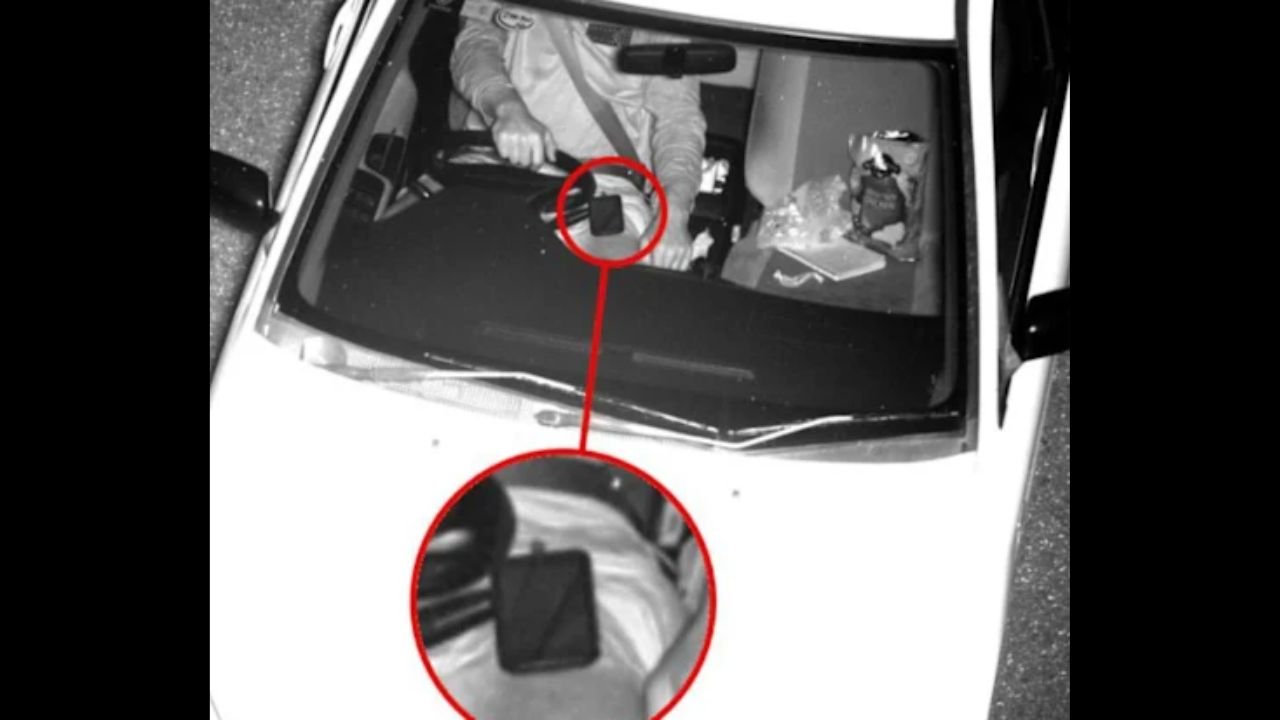
A South Australian driver has raised questions about mobile-phone detection cameras after an object photographed on his lap was judged to be a phone — while he insists it was actually his wallet.
The Adelaide tradie, identified only as Mick, challenged the infringement after a detection camera photographed him travelling on the North-South Motorway at Regency Park.
Mick acknowledged that the dark object captured by the overhead camera could resemble a smartphone. But he maintains he was not carrying a phone on his lap and says he can explain exactly why his wallet was there.
The dispute ultimately reached court, where Mick decided against pursuing a full trial because of the potential time away from his small business.
Camera Detection
The incident occurred in November 2025 as Mick drove along the North-South Motorway in Adelaide’s north.
According to his account, he had recently stopped at a service station to buy snacks and paid using his wallet rather than a digital payment service.
After returning to his vehicle, he says he placed the wallet on his lap because he did not want to sit with it in his back pocket.
A mobile-phone detection camera subsequently captured an image showing a dark rectangular object resting on him.
The infringement was later issued by South Australia Police.
$678 Penalty
Mick received a $678 financial penalty and three demerit points under the penalty settings applying to his infringement.
He disputed the allegation and argued that the camera image had been misinterpreted.
His friend Deb assisted him with the challenge because English is Mick’s second language. She said the shape and other details visible in the photograph were consistent with his wallet, including a distinctive tab.
To support the challenge, Mick supplied a photograph of the wallet along with a signed statutory declaration stating that it was the object visible in the detection image.
That evidence did not result in the infringement being withdrawn.
Review Rejected
South Australia Police rejected Mick’s review.
According to correspondence reported in connection with the case, authorities maintained that the object visible in the detection photographs appeared to be a mobile phone and that the material submitted did not provide sufficient contrary evidence.
Mick then elected to take the matter to court.
His case highlights an important part of South Australia’s detection process that can sometimes be overlooked: artificial intelligence does not independently make the final decision to issue an infringement.
The state’s official road-safety information says AI initially processes camera images and identifies suspected illegal phone use. Images flagged by the system are then reviewed by a trained SAPOL adjudication officer before an expiation notice is issued.
Court Decision
Mick initially intended to contest the allegation in court, but he became concerned about the practical consequences of continuing to trial.
As a self-employed worker, spending several days dealing with court proceedings could mean losing income as well as facing the possibility that the original penalty would ultimately be upheld.
He instead chose to plead guilty under an outcome that reduced the financial penalty and removed the demerit points.
According to Mick’s account, the court treated the alleged phone as an object that was resting on his lap rather than actively being operated.
Although avoiding the demerit points provided some relief, Mick continues to maintain that the object wasn’t a phone.
Law Changed
The case also comes against the backdrop of a significant 2026 change to South Australia’s mobile-phone rules.
From 12 February 2026, the state’s regulations expressly define mobile-phone “use” to include resting the body of a phone on any part of the driver’s body, even when the driver isn’t making a call or operating another function.
There is an exception where a phone is kept in a clothing pocket or wearable pouch and isn’t being operated.
Current South Australian guidance consequently tells motorists that a phone should not be resting on their lap while driving.
A vehicle stopped at traffic lights is still considered to be in traffic for these rules. A driver can use a handheld phone without those driving restrictions once the vehicle is legally parked.
The distinction is particularly relevant to Mick’s claim: his argument isn’t that drivers may legally keep a phone on their lap, but that the object photographed wasn’t a phone in the first place.
Cameras Expand
South Australia introduced its first mobile-phone detection cameras in June 2024, initially operating five sites around metropolitan Adelaide.
A three-month education period followed before fines began on September 19, 2024.
The Regency Park site where Mick was photographed has proved particularly active.
By December 2025, the South Australian Government reported that the original five camera locations had caught close to 80,000 motorists, with about 21,000 expiation notices attributed to the Regency Park location.
Authorities subsequently announced additional camera locations at Valley View and Felixstow, while planning continued for a wider expansion of the network.
Fine Now $700
Drivers should also be aware that the financial penalty has increased since Mick received his infringement.
Under the rates effective from July 1, 2026, illegal mobile-phone use detected by the system attracts a $592 expiation fee plus a $108 Victims of Crime Levy for an adult.
That takes the immediate financial cost to $700, along with three demerit points.
South Australia’s demerit-point system can create further consequences for motorists who accumulate multiple offences. A fully licensed driver who reaches 12 or more points within three years faces disqualification, while stricter thresholds apply to learner and provisional drivers.
Human Review
Authorities maintain that the technology has an important road-safety purpose.
Official figures show camera detections fell substantially after enforcement began, suggesting motorists changed their behaviour after the system was introduced. SAPOL reported 46,476 expiation notices during the first six months of enforcement to March 18, 2025.
Government guidance also stresses that suspected offences identified by AI undergo human review before a fine is issued.
Mick’s dispute, however, illustrates the difficult question that can arise when an image appears open to interpretation.
For South Australian motorists, the current rule itself is clear: a mobile phone should not be held or rested on the driver’s body while the vehicle is moving or stationary in traffic.
Mick says his situation was different for one fundamental reason.
The object on his lap, he maintains, was never a phone at all.