
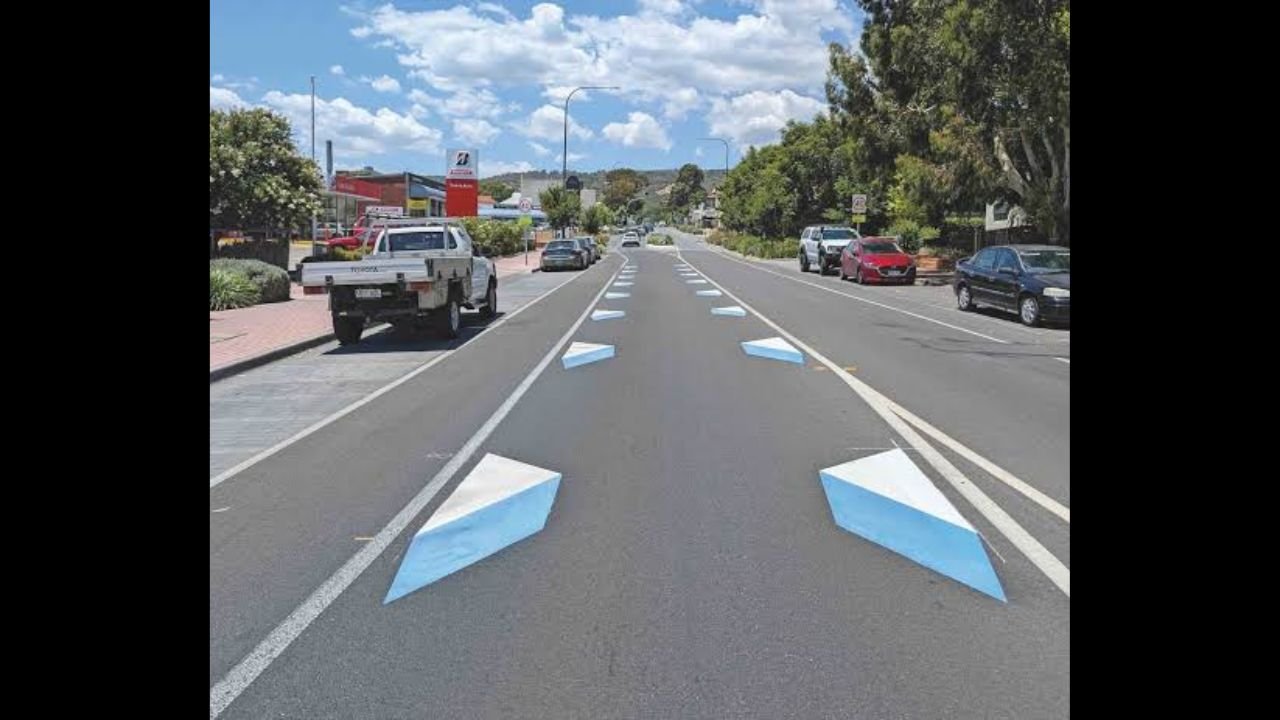
Unusual blue-and-white road markings designed to make Australian motorists slow down are attracting attention for an unexpected reason, with some drivers arguing the eye-catching treatment could itself become a distraction.
Known as “dragon’s teeth”, the three-dimensional-style markings are being trialled in South Australia to encourage motorists to notice when they are approaching lower-speed areas with increased pedestrian activity.
The markings create an optical effect that can appear to rise from the road surface as a vehicle approaches. Despite their unusual appearance, they are not physical bumps or obstacles drivers need to avoid.
The South Australian trial is being studied by road safety researchers from the University of Adelaide, with the state’s Department for Infrastructure and Transport involved in the project.
Researchers are interested in whether a highly visible change to the road surface can prompt motorists to reduce their speed before entering a 40km/h zone.
Where they are
The treatment has appeared at several South Australian locations, with Magill Road, Seaview Road, Prospect Road and Beach Road at Christies Beach among the roads included in the expanded trial.
Similar dragon’s teeth treatments have also appeared in parts of New South Wales and Victoria, although designs and purposes can vary between locations.
The Royal Automobile Association of South Australia has drawn fresh attention to the trial, reminding motorists that the markings are intended as a visual warning that conditions ahead are changing.
Rather than relying only on a roadside speed sign, the treatment puts an additional signal directly within a driver’s field of vision.
Why 3D?
The markings use triangular shapes and contrasting colours to produce the illusion of depth.
They are made from thermoplastic road-marking material, meaning motorists continue driving over them rather than steering around them as they would a real obstruction.
University of Adelaide road safety scientist Mario Mongiardini has explained that the visual effect is intended to capture attention at locations where drivers may otherwise fail to recognise an approaching change in the road environment.
That could include a relatively straight section of road where the posted limit suddenly falls and there is little else to make a motorist instinctively reduce speed.
The treatment effectively provides an additional visual cue before drivers enter an area where pedestrians face greater risk.
Drivers react
Not everyone is convinced that making the road look unusual is the right approach.
Some motorists responding to images of the markings have described them as distracting or potentially dangerous, particularly when encountered for the first time.
One concern is that a driver unfamiliar with the design could initially interpret the optical illusion as an object sitting on the road.
Others have questioned whether directing a motorist’s attention towards a visually striking surface treatment could momentarily take their focus away from pedestrians, vehicles and other hazards ahead.
Wet weather and darkness have also been raised as concerns because reflections, headlights and reduced visibility could alter how the markings appear.
Those reactions are particularly relevant to the trial because researchers are examining real-world driver behaviour rather than simply whether motorists notice the design.
Not everywhere
Researchers do not envisage covering Australian streets with the distinctive triangles.
Instead, dragon’s teeth are being investigated as a targeted treatment for locations where there is a specific need to make drivers recognise a transition in road conditions.
One potential example is a straight road entering a busy shopping strip or pedestrian precinct.
Drivers can sometimes maintain their previous speed when the physical appearance of a road does not noticeably change, even though the speed limit has fallen.
A conspicuous surface treatment could make that transition harder to overlook.
If effective, the approach also offers authorities an advantage over major infrastructure changes because road markings can generally be installed more quickly and at substantially lower cost than rebuilding a street.
Small reduction matters
The trial is not necessarily expected to produce dramatic reductions in vehicle speeds.
Researchers are looking at whether the treatment can produce a relatively modest change of around 4km/h to 5km/h.
While that might appear small, lower impact speeds can make an important difference to crash severity, especially when vulnerable road users such as pedestrians are involved.
Vehicle speed affects both the time available for a driver to react and the forces involved if a collision occurs.
A motorist travelling more slowly has additional time to identify a developing hazard, brake and potentially avoid a crash. If a collision cannot be avoided, reducing speed can also lower the energy transferred during the impact.
What drivers do
The markings do not create a new road rule or a separate speed limit.
Drivers encountering them should continue following the posted speed signs and normal road rules, while recognising that the treatment is intended to highlight a change in the driving environment.
There is no need to swerve around the triangles or treat them like speed humps.
Their purpose is visual: motorists should recognise the warning, check the applicable limit and be particularly alert for pedestrians and other road users.
That distinction could become increasingly important if the markings appear at additional locations and more drivers encounter them for the first time.
Results coming
Researchers are expected to assess the trial data to determine whether the markings actually change motorists’ behaviour.
The key question is whether drivers consistently reduce their speed after encountering the treatment rather than merely noticing its unusual appearance.
Researchers will also need to consider whether any observed effect continues after motorists become familiar with the markings. A treatment that initially attracts attention may become less noticeable to people who drive through the same location every day.
The findings will help authorities determine whether dragon’s teeth deserve a wider role in Australia’s road safety toolkit.
Wider rollout?
A successful trial could lead to similar 3D-style markings being considered for other high-pedestrian locations, particularly where authorities want a relatively quick and inexpensive method of encouraging lower speeds.
Any broader rollout would still depend on the results and decisions by individual road authorities.
For now, the distinctive triangles remain a trial rather than a new nationwide road standard.
The debate surrounding them highlights the challenge facing road safety authorities: a warning needs to be noticeable enough to change driver behaviour without becoming such a strong visual feature that motorists find it distracting.
Whether Australia’s dragon’s teeth achieve that balance will become clearer once researchers have analysed how motorists actually respond to them.